

A capped frame of honeycomb, heavy enough to bow the wire, is the reward that makes the stings worthwhile. It is also the moment to slow down. Open a hive carelessly and you will have bees in the air, honey running down the frames and a colony spending the next week repairing damage instead of settling down for autumn. Done well, harvesting is a calm twenty minutes at the hive and a sticky afternoon in the kitchen — and the bees barely notice you were there.
When the Honey Is Ready to Come Off
Honey is ready when the bees say so. They cap the comb once the nectar inside has been fanned down to a moisture level that will keep, broadly somewhere under about 18 per cent. That pale wax lid is the signal you are waiting for. Lift a frame and look across the surface: if nearly all the cells are sealed, with only a few open ones around the edges, it can come off.
If more than a quarter of a frame is still open, leave it another week. You can also try the shake test: hold the frame flat over the hive and give it one sharp downward jolt. If droplets of nectar fly out, it is not ready.
In most of the UK this falls between late July and early September, but the flow and the weather decide, not the calendar. Choose a warm, still morning. The bees are gentler, the honey is thinner and easier to spin, and you are not wrestling with rain blowing into an open hive.
Clearing the Bees Without a Fight
The commonest beginner's mistake is shaking bees off each frame by hand. It works, but it upsets the colony, crushes a few workers and leaves angry bees following you back to the kitchen.
A clearer board is kinder. This is a thin board with a one-way bee escape in the middle. Slide it between the brood box and the supers in the evening, once the foragers are home. Overnight the bees find their way down through the escape and cannot work out how to get back up, and by mid-morning the supers are usually empty.
If a handful of bees remain, brush them off with a soft bee brush or a leafy twig rather than your fingers, and keep the super covered with a cloth. Never leave frames of honey standing open near the hives. Within minutes, every colony in the apiary will be robbing them.
Uncapping: Take the Lid Off, Not the Comb
Uncapping means slicing the wax seal away so the honey can spin out. Work over a tray or a large roasting tin with the frame standing upright, so the honey runs down into it rather than across your floor.
A sharp, warm uncapping knife does most of the job. Draw it across the surface with a gentle sawing motion, keeping the blade almost flat against the comb and cutting just under the cappings. Do not dig in. Every centimetre of comb you shave off is wax the bees must rebuild, and that costs them energy they would rather spend on winter stores.
For dips and low spots, use an uncapping fork — a small rake you draw through the wax to scratch it open. Keep uncapped frames in a lidded box as you go, and save the cappings in a sieve over a bowl. They hold a surprising amount of honey, which will drain out over a day or two.
Spinning, Straining and Settling
- Set the extractor on a level surface and load the frames with their top bars facing outwards.
- Start slowly. A few gentle turns get the honey moving; then build up speed. Spin hard from cold and you will blow out the comb.
- Turn each frame and spin the other face, then flip it and repeat, so you take roughly half from each side in turn rather than emptying one side completely.
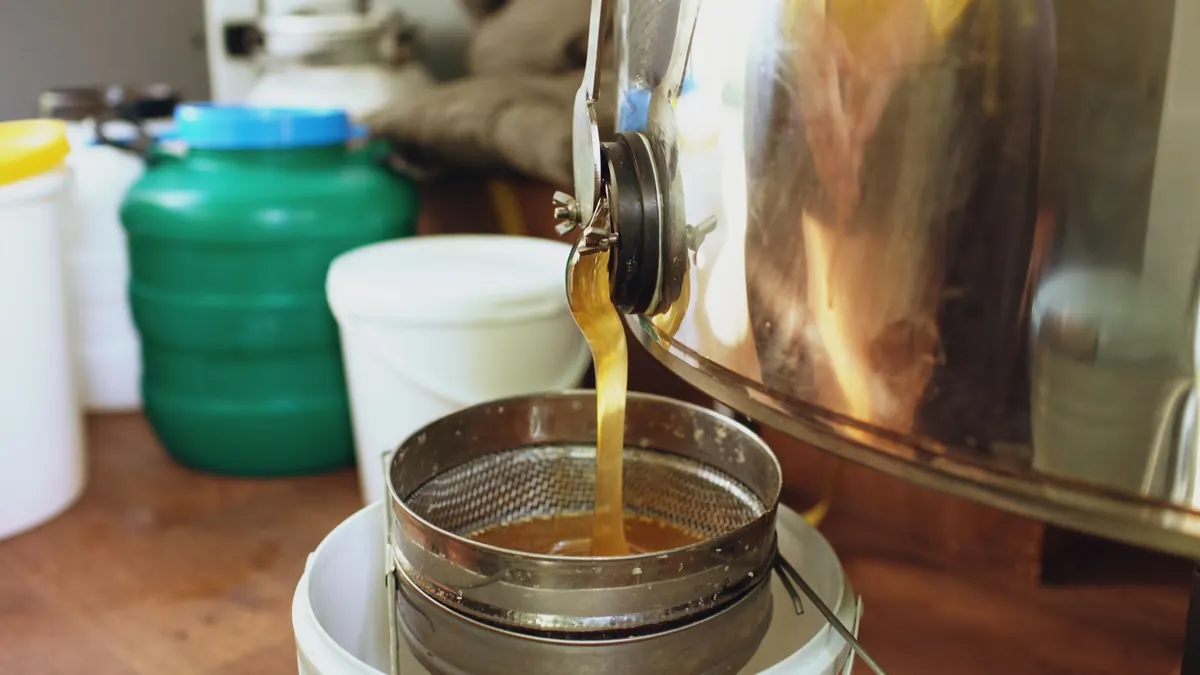
- Run the honey from the tap through a double sieve into a food-grade bucket and leave it to settle for a few days.
Settling matters. Bubbles, wax fragments and the odd bee rise to the surface, and you can skim them off before jarring. There is no need to heat anything: a warm room is enough. Heat drives off the aromatic compounds that make your honey taste of the field it came from.
Leave Them More Than You Think They Need
This is the part that decides whether your bees see spring. A colony needs a serious weight of stores to get through a British winter. Many beekeepers aim for something in the region of 15 to 20 kg, and more in cold, wet upland areas or for a large colony in a big brood box.
What to Leave
The honey in the brood box belongs to the bees; the supers are your crop. Work out what you are leaving before you take anything. If the season has been poor, or the frames you pull are barely capped, leave them in place and take nothing at all.
Feeding a Light Colony
If stores look short by late August or early September, feed thick syrup — around two parts sugar to one part water by weight — through a rapid feeder, and keep going until the hive feels heavy when you lift it. Ivy and other late flowers may add something, but never rely on them. Take the feeder off before the colony clusters, and remember that syrup is for the bees, not for jars.
A Harvest You Can Repeat Next Year
Clean your extractor, buckets and sieves the same day. Set honey is far harder to shift than the wet, sticky stuff you are dealing with now. Store your crop in sealed buckets somewhere cool and dark, labelled with the date and the apiary it came from.
If you plan to sell any of it, check your local food hygiene requirements first. And one safety note worth repeating: honey should not be given to babies under one year old.
Take the surplus, leave the stores, and leave the comb in good shape. Do that, and next season begins with a stronger, calmer colony — which is the only kind of harvest worth having.
Photo: Vitaly Gariev / Pexels